
The usual fixes, $150–$600
Elements, thermostats, thermocouples, relief valves: the parts that actually fail, tested and swapped in one visit.
No hot water is a today problem, so we treat it like one. Gas, electric, continuous-flow and heat-pump systems repaired same-day across Annangrove, and when a system is genuinely done, you get the honest replace-versus-repair numbers, not a sales pitch.
Most of the no-hot-water calls we take in Annangrove end in a repair, not a skip bin. Electric systems lose elements and thermostats; gas systems lose thermocouples and pilot assemblies; continuous-flow units throw error codes that mean a sensor or a flow problem, not a dead unit. Those are parts, they are stocked on the van, and the fix is measured in hours.
The industry default is the opposite, quote a shiny new system to anyone whose water went cold, because a replacement is worth ten times a thermostat. We diagnose first. A five-year-old tank with a failed element deserves an element. What it does not deserve is a $2,000 replacement because someone could not be bothered testing a $40 part.

Rainwater is soft and often slightly acidic, which is easier on a cylinder than hard water in some respects and harder on the anode in others. Sediment carried from a tank is the bigger issue, it settles in the bottom of a storage unit and insulates the element.
With 99.0% of Annangrove dwellings recorded as separate houses by the ABS 2021 Census, above the NSW figure of 65.6%, almost every system we attend is a storage tank in a garage, side passage or external alcove.
On tank supply, flushing the hot water unit annually matters more than it does on mains, and a properly maintained filter upstream extends the life of everything after it.
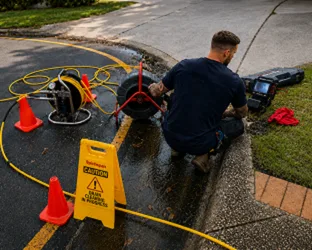
On large blocks the run from the house to the tank, trench or street can be tens of metres, so grades flatten, silt settles and a camera is needed to find the trouble spot.
The honest constraint on a rural property is not the repair, it is the second trip. If a part is not on the van, the gap between diagnosis and fix is longer here than in the suburbs.
So we ask more questions on the phone for properties out this way, make, model, age, and what it is doing, specifically so the right parts travel with the plumber the first time.
Annangrove sits out in Sydney’s semi-rural Hills District (postcode 2156), an acreage suburb of large rural-residential blocks, horse properties and bushland bordering Kenthurst, Box Hill, Rouse Hill and Glenhaven. Many homes here run on septic or on-site wastewater and tank water, with long private drain lines crossing big blocks, and we know this ground well.
Properties beyond the gas network are choosing between electric storage, a heat pump, solar thermal with a booster, or bottled LPG. Each has a genuinely different cost profile and none of them is obviously right for every household.
The deciding factors are usually roof orientation, how many people are in the house, and whether there is solar generation to soak up. We will work through it with your actual numbers rather than a default recommendation.
Two different faults look identical from the shower. Either the system has stopped heating, or it is heating and the hot is not reaching you.
Check another tap, ideally at the opposite end of the house. Hot everywhere else means a tap or mixer fault, not a heater fault. Nothing hot anywhere points at the unit, its power or gas supply, or the pipe leaving it: and that is worth knowing before anyone quotes on a replacement.
Inside every storage cylinder is a sacrificial anode that corrodes so the steel does not. When it is consumed, the tank starts consuming itself, and that is the point of no return.
Replacing an anode costs a fraction of replacing a tank and roughly doubles its service life. Almost nobody does it, because almost nobody is told it exists, which is why it is here rather than in the fine print.
Hot water systems give more notice than they get credit for. Rusty or discoloured hot water, a recovery time that has quietly doubled, a relief valve that has started weeping continuously, banging or rumbling from the tank, or damp around the base.
Any one of those is worth a look. Together they are a unit telling you to choose the replacement date yourself rather than have it chosen on a winter morning.
Three things decide it: the age of the unit, the cost of the failed part, and whether the cylinder itself is sound. A tank under about eight years old with a failed element, thermostat or valve is almost always worth repairing.
A tank that has rusted through is finished, and no part saves it. We would rather tell you that than sell a repair that buys a month, and you should expect to be shown why, not just told.
Elements, thermostats, thermocouples, relief valves: the parts that actually fail, tested and swapped in one visit.
Gas valves and continuous-flow control boards, on systems young enough to deserve the investment.
Installed, like for like. Gas storage lands at $1,200–$2,200 installed.
Installed. Endless hot water, nothing to rust through, and the cupboard back.
Installed, after rebates: and the cheapest of everything to actually run. Worth the comparison on every replacement.
Repair and replacement prices arrive together when the tank is marginal, you decide with both in hand. Figures here are indicative of the 2026 Sydney market rather than a quote from us, you get your own number as a fixed price before any work starts.

System type, age, and what it is doing: that is usually enough to bring the likely part on the van and tell you honestly whether today ends in hot water.
Elements get metered, thermostats tested, gas components checked in sequence. The diagnosis is what the meter says, not what sells best.
A repairable fault gets repaired on the spot. A dying tank gets you the repair price and the replacement price side by side, and the call stays yours.
If it is a replacement: delivered, installed to spec: tempering valve, relief drain, compliant connections: old unit carted away, hot water the same day in most cases.
Call before mid-morning and tonight’s shower is usually hot. Describe the system; the likely part rides along.
Instruments before invoices, parts before replacements, and a fixed price before either.

Leave your details and our local Annangrove team will call you back fast.