
Reachable burst: $200–$500
Garden, garage or open wall access, cut out and repaired at daytime rates.
Water finds the ceiling fast and the cause slowly, the wet patch is almost never over the split. We shut it down, trace the failure to its source, and repair the pipe rather than bandaging the symptom. Around the clock across Annangrove and the Hills District.
Most of what bursts around Annangrove is age meeting pressure. Original copper lines from the mid-century build era wear thin from the inside until a pinhole opens; older galvanised steel rusts until a fitting lets go; and garden poly lines split where a root or a shovel found them years ago. Add mains pressure that runs high across parts of the Hills District, and the weakest point eventually announces itself.
The catch is that water travels. It runs along the outside of the pipe, along joists and wall plates, and surfaces somewhere downhill of the actual split, which is why the wet patch on the ceiling is so often metres from the leak. Repairing where the water shows up fixes nothing. We trace the line back to the failure itself, repair that, and pressure-test before closing anything back up.


Annangrove sits out in Sydney’s semi-rural Hills District (postcode 2156), an acreage suburb of large rural-residential blocks, horse properties and bushland bordering Kenthurst, Box Hill, Rouse Hill and Glenhaven. Many homes here run on septic or on-site wastewater and tank water, with long private drain lines crossing big blocks, and we know this ground well.
Mains pressure varies with elevation, and properties low on a slope frequently sit at the high end of the range. Higher standing pressure shortens the life of every fitting in the house, particularly flexible hoses under sinks and behind toilets.
If you are at the bottom of a hill and you have had more than one fitting let go, a pressure test is worth doing. A pressure-limiting valve is a small part that prevents an expensive category of failure.
On sloping ground water leaves a failed pipe and travels, following the easiest path under the surface until something stops it. It can emerge metres downhill, in a neighbour's yard, or against a retaining wall.
So digging where the water appears is usually digging in the wrong place. Correlation and acoustic equipment work uphill from the symptom, which on a steep block routinely saves several metres of unnecessary excavation.
Sloping properties are full of retaining structures, and services frequently run behind or beneath them because that was the only route available. A leak in that position is both harder to reach and more consequential, saturated backfill is what makes retaining walls fail.
If water is showing at the base of a wall, treat it as urgent even if the volume looks trivial. The plumbing repair is minor next to what the wall costs.
Sydney does not freeze pipes, so the causes are age, pressure, movement and workmanship. Corrosion thins a wall until it opens; high standing pressure fatigues fittings; ground movement pulls joints apart; and a connection that was never quite right eventually proves it.
Which one you have determines whether this is a one-off repair or the first of several. That is the question worth answering while the plumber is already there.
Not every burst announces itself. A pressure leak under a slab or inside a wall can run for months, and the symptoms are indirect: a water bill climbing without explanation, a warm patch on the floor, a musty smell, paint lifting at skirting level.
The free first test is your meter. Turn every tap off, note the reading, and check it an hour later. If it has moved, water is leaving somewhere, and that is worth finding before it finds you.
That bang when a tap or washing machine valve shuts is a pressure wave hitting a dead end. It stresses every joint in the system, and over years it is a genuine cause of premature failure rather than merely an annoyance.
It is usually fixable cheaply, arrestors, a pressure-limiting valve, or simply re-securing pipework that has come loose. If your house bangs, it is worth mentioning while we are there for something else.
Garden, garage or open wall access, cut out and repaired at daytime rates.
Wall and ceiling repairs, including the tracing that keeps the access hole singular and small.
Locating gear plus concrete or excavation access: or a smarter reroute around the lot.
Roughly $180–$250/hr versus $120–$160 daytime, plus attendance. Meter off + morning booking is sometimes the clever play; we will say so.
Professional leak detection's first hour. Cheaper than the second exploratory hole, let alone the third.
Every repair leaves pressure-tested and carries a lifetime workmanship warranty. Figures here are indicative of the 2026 Sydney market rather than a quote from us, you get your own number as a fixed price before any work starts.
On the phone: meter valve, clockwise, done: the flooding stops before we have left the depot. On site, we isolate just the affected line where possible so the rest of the house stays on.
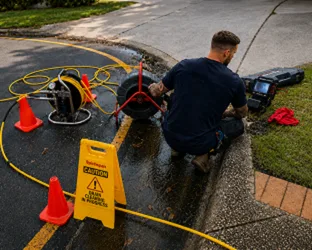
Water surfaces downhill of the failure, so we trace: acoustic gear, thermal imaging or pressure testing for concealed lines, before anything is opened up.

The failed section is cut out and replaced, not bandaged. If what we expose says the whole run is at end of life, you get that assessment straight, with numbers for both paths.

Pressure-tested against the mains before any wall, floor or trench is closed. You see it holding before we leave.
The crisis ended when the meter closed. Call now and the repair gets planned properly, not frantically.
What people ask us with the water off, answered before you need them.

One fixed price, one properly repaired pipe, one pressure test you watch pass. That is the whole offer.

Leave your details and our local Annangrove team will call you back fast.